
Latest Posts
Python Project
With the official launch of the NLPPlus Python package, we are now focusing on the best way to introduce it to the Python community. The major message? NLPPlus is NLP that is 100% customizable. Where other NLP packages and toolkits are turnkey and supposedly do not require any customization, they […]
Read more
Elisha Silas
Elisha K. Silas is a computer scientist specializing in distributed systems and cloud computing, with a strong focus on scalable server-side application development and AI-driven solutions. He holds a bachelor’s degree in information systems and technologyfrom the United States International University Africa and brings four years of professional experience in designing […]
![]()
First NLP++ College Workshop for College Credit a Success
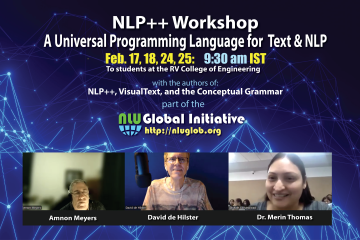
Four-Day NLP++ Workshop at RVCE University Computer science students at RVCE University in Bengaluru India were given an up-close look at NLP++, the universal programming language for text and NLP, by co-authors David de Hilster and Amnon Meyers. This was the first NLP++ workshop offered for college credit. NLUGLI and […]
![]()
NLP Workshop for RVCE Coding Club
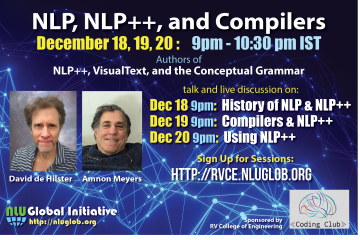
NLP++ authors David de Hilster and Amnon Meyers will be conducting a virtual workshop on NLP, NLP++, and Compilers from December 18 – 20, 2024. Sign Up For Each Session Here are the three sessions and a link to sign up. YOU MUST SIGN UP FOR EACH SESSION SEPARATELY. The […]
![]()
RV University and NLU Global Initiative Announce Cooperation
The Computer Science & Engineering Department at RV University in India has come to a long-term formal agreement with the Natural Language Understanding Global Initiative to work on rule-based NLP. Lead by Dr. G Shobha, dean of the School of Computer Science and Engineering, and Dr. Merin Thomas, the school […]
![]()
Dr. Merin Thomas
Dr Merin Thomas, currently working as Associate Professor in the School of Computer Science and Engineering, R V University. She has her Specialization in Machine Learning and Artificial Intelligence. Her area of research is in Natural Language Processing. She is a Passionate Teacher and has several research articles to her […]
![]()
Building an NLP++ Brazilian Address Cleaner for HPCC SystemsÂ
Live Talk Open to the Public Watch a video of the live presentation of this NLP++ analyzer for Brazilian addresses during the 2024 HPCC Systems Community Summit. It took place on Wednesday, October 8, at 9:00 am EST USA online. It was free to register and attend. Using the NLP++ […]
![]()
Regex for NLP
Regex is ubiquitous in the programming world because of its usefulness as a rule-based text parsing language. Programmers find comfort in the idea of writing explicit, modifiable rules in order to parse text. This is in contrast with black-box statistical models, which cannot be modified when things go wrong – […]
![]()
ACL 2024 in Bangkok Thailand: Revelations of Old and New
I have been in computational linguistics for more than 40 years, and this is the first time I have been to the most important conference in our field: the annual Association of Computational Linguistics (ACL) Conference. As part of the registration process, I became a member for the first time […]
![]()
Guilherme Santos da Silva
Guilherme Santos da Silva has a degree in Computer Engineering from the Federal Technological University of Paraná, Brazil and is currently an employee of LexisNexis Risk Brazil. He discovered HPCC Systems in 2021 when he joined LexisNexis as an intern and participated in the 2021 HPCC Systems Poster Contest with […]
![]()
Scalable Analysis of English Dictionary Files on HPCC Systems Big Data Platform
Congratulations to Jayanth C on presenting his paper on Scalable Analysis of English Dictionary Files on HPCC Systems Big Data Platform at a conference in Japan. Read more about it on LinkedIn. Here are links to the paper online:
![]()
NLP++ and LLM
Trustworthy NLP systems must be rule and knowledge based given all statistical systems like large language models, machine learning, and neural networks are not. With the advent of large language models that can be queried about common knowledge, it is natural to use them to generate linguistic and world knowledge […]
![]()