Inside Version 4 of the VisualText NLP++ Engine: Now You Can Watch It Run
You can now set a breakpoint, run your analyzer, stop on the exact rule or the exact line, and look at what the engine is holding at that moment. The glass box now has a door.



You can now set a breakpoint, run your analyzer, stop on the exact rule or the exact line, and look at what the engine is holding at that moment. The glass box now has a door.

Northeastern University is launching an innovative, zero-credit course that leverages blockchain technology and the rule-based programming language NLP++ to build a decentralized, human-driven natural language processing ecosystem.
Compiling NLP++ analyzers is now a single click. Version 3 brings native-code speed and lets you deploy analyzers without exposing your source.
Read more
You can now set a breakpoint, run your analyzer, stop on the exact rule or the exact line, and look at what the engine is holding at that moment. The glass box now has a door.

Why the first universal language for deterministic text analysis was never a matter of taste — and why it took a machine built out of statistics to finally prove the point.
Read more
NLP++ is parsed by an analyzer written in NLP++, and its knowledge lives in a Conceptual Grammar whose lineage runs back through 1995 C code to a DARPA system built on LISP machines in 1983. Here is how Amnon Meyers built it.
Read more
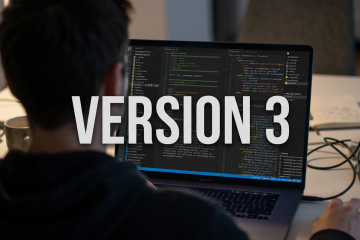
Version 3 has been the biggest chapter yet for the NLP++ extension for Visual Studio Code. What started as a way to compile and run analyzers has grown into a complete development environment for the NLP++ language — with the kind of code intelligence you’d expect from a first-class programming language. […]
Read more
Yes, you can have Claude write NLP++ for you — and no, that doesn’t make it another black box. This step-by-step guide takes you from a blank machine to a working analyzer: install VS Code, add the NLP++ extension, run Claude Code, and use the built-in prompts to generate real, glass-box code. What you keep is deterministic, auditable, and runs on its own — no model required.

I spent the last 8 weeks using Claude to eventually replace Claude. Ironic…
Read more
One of the strengths of NLP++ is that once you’ve written an analyzer in the VisualText VS Code extension, you are not locked into a single way of running it. The same glass-box, 100% rule-based analyzer can be driven from Python, from Node.js, from TypeScript, or straight from the command […]
Read more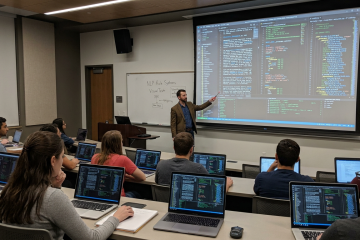
For most of its life, the NLP++ engine has been a powerful tool for writing rule-based analyzers — explainable, glass-box, and deterministic natural-language processing you can actually read, debug, and reproduce exactly. It has run on Windows, Linux, and macOS for years. What Version 3 changes is how you build, […]
Read more
LLMs guess. NLP++ understands. And that difference is exactly why NLP++ is the only technology positioned to eventually replace large language models in real‑world text processing. LLMs are probabilistic black boxes. They don’t know anything; they predict. They require teaming — layers of prompts, validators, guardrails, and secondary models — […]
Read more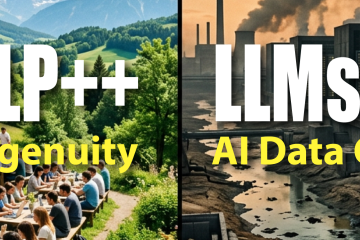
With our NLP++ textbook coming out world-wide this month (it may be already out by the time you read this), people are asking: what is the difference between LLMs and NLP++? Here is a first attempt of mine to explain. NLP++ and LLMs aren’t two approaches to the same problem. […]

Our neural network brains are bamboozled by the “average”, but we “average” people are waking up. This explains why we are so easily fooled and how human ingenuity can get us out of this (A)verage (I)ndustry mess.

In recent comment threads and after reading the ubiquitous posts on “AI” on LinkedIn, I have come to the revelation that we are living in the “era of shallow thinking”. And it is this problem that is holding us back from doing more “profound” things in computer science.

Muhammad Ahmad: Pioneering Decentralized AI with a Human-Centric Approach Muhammad Ahmad is a distinguished blockchain developer and researcher whose expertise lies at the critical intersection of decentralized systems, Artificial Intelligence, and secure data interaction. A Computer Science graduate from FAST NUCES, he consistently demonstrated academic excellence, earning recognition on the […]