
Eight Weeks with Claude and NLP++
I spent the last 8 weeks using Claude to eventually replace Claude. Ironic…
Read more

I spent the last 8 weeks using Claude to eventually replace Claude. Ironic…
Read more
One of the strengths of NLP++ is that once you’ve written an analyzer in the VisualText VS Code extension, you are not locked into a single way of running it. The same glass-box, 100% rule-based analyzer can be driven from Python, from Node.js, from TypeScript, or straight from the command […]
Read more
For most of its life, the NLP++ engine has been a powerful tool for writing rule-based analyzers — explainable, glass-box, and deterministic natural-language processing you can actually read, debug, and reproduce exactly. It has run on Windows, Linux, and macOS for years. What Version 3 changes is how you build, […]
Read more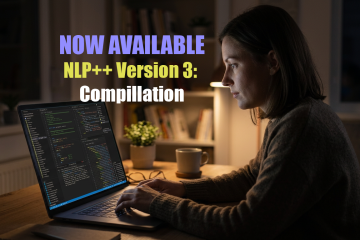
Compiling NLP++ analyzers is now a single click. Version 3 brings native-code speed and lets you deploy analyzers without exposing your source.
Read more
LLMs guess. NLP++ understands. And that difference is exactly why NLP++ is the only technology positioned to eventually replace large language models in real‑world text processing. LLMs are probabilistic black boxes. They don’t know anything; they predict. They require teaming — layers of prompts, validators, guardrails, and secondary models — […]
Read more