NLP++ Version 3: Compiled Analyzers, Faster Execution, and Protected Code
Compiling NLP++ analyzers is now a single click. Version 3 brings native-code speed and lets you deploy analyzers without exposing your source.
Read more
Compiling NLP++ analyzers is now a single click. Version 3 brings native-code speed and lets you deploy analyzers without exposing your source.
Read more
LLMs guess. NLP++ understands. And that difference is exactly why NLP++ is the only technology positioned to eventually replace large language models in real‑world text processing. LLMs are probabilistic black boxes. They don’t know anything; they predict. They require teaming — layers of prompts, validators, guardrails, and secondary models — […]
Read more
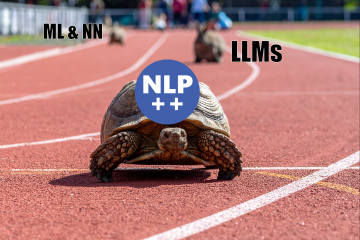
With our NLP++ textbook coming out world-wide this month (it may be already out by the time you read this), people are asking: what is the difference between LLMs and NLP++? Here is a first attempt of mine to explain. NLP++ and LLMs aren’t two approaches to the same problem. […]
![]()
Our neural network brains are bamboozled by the “average”, but we “average” people are waking up. This explains why we are so easily fooled and how human ingenuity can get us out of this (A)verage (I)ndustry mess.
![]()
In recent comment threads and after reading the ubiquitous posts on “AI” on LinkedIn, I have come to the revelation that we are living in the “era of shallow thinking”. And it is this problem that is holding us back from doing more “profound” things in computer science.
![]()
Northeastern University is launching an innovative, zero-credit course that leverages blockchain technology and the rule-based programming language NLP++ to build a decentralized, human-driven natural language processing ecosystem.
![]()
David de Hilster is on the warpath. He is tired of all the “hype” vocabulary used in “AI”. Find out how he plans to change this with simple word changes.
![]()
Before you panic and spend $1995 on that “Prompt Engineering” class, read this book. It will not only save you lots of money, but it will save two of the most important things you have: your time and your sanity.
![]()
The co-authors David de Hilster, and Amnon Meyers, of the NLP++ programming language and framework are finishing up their first textbook on NLP++ entitled: “Rule-Based NLP with NLP++”. They are looking to have the book ready by fall 2025 in time to be used by RVCE University which is planning […]
![]()
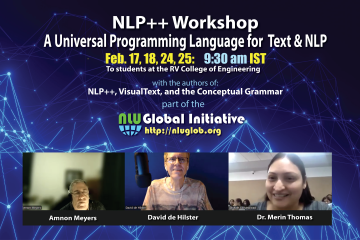
Four-Day NLP++ Workshop at RVCE University Computer science students at RVCE University in Bengaluru India were given an up-close look at NLP++, the universal programming language for text and NLP, by co-authors David de Hilster and Amnon Meyers. This was the first NLP++ workshop offered for college credit. NLUGLI and […]
![]()
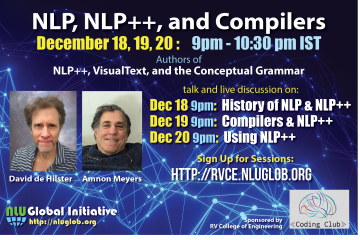
NLP++ authors David de Hilster and Amnon Meyers will be conducting a virtual workshop on NLP, NLP++, and Compilers from December 18 – 20, 2024. Sign Up For Each Session Here are the three sessions and a link to sign up. YOU MUST SIGN UP FOR EACH SESSION SEPARATELY. The […]
![]()
The Computer Science & Engineering Department at RV University in India has come to a long-term formal agreement with the Natural Language Understanding Global Initiative to work on rule-based NLP. Lead by Dr. G Shobha, dean of the School of Computer Science and Engineering, and Dr. Merin Thomas, the school […]
![]()
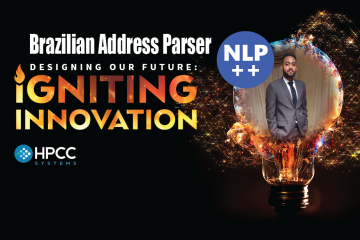
Live Talk Open to the Public Watch a video of the live presentation of this NLP++ analyzer for Brazilian addresses during the 2024 HPCC Systems Community Summit. It took place on Wednesday, October 8, at 9:00 am EST USA online. It was free to register and attend. Using the NLP++ […]
![]()
Regex is ubiquitous in the programming world because of its usefulness as a rule-based text parsing language. Programmers find comfort in the idea of writing explicit, modifiable rules in order to parse text. This is in contrast with black-box statistical models, which cannot be modified when things go wrong – […]
![]()